Types of Firearms – Part 2: Handguns
Pistols and Revolvers
Handguns are compact, portable firearms designed to be fired with one hand. They are widely used by civilians, law-enforcement agencies, and military personnel for personal defense, duty carry, and sport shooting.
The two primary handgun categories are pistols and revolvers. While both serve similar purposes, their internal mechanisms and handling characteristics differ significantly.
Handguns Overview
Handguns are valued for their portability, quick deployment, and close-range effectiveness. Compared to long guns, they are easier to carry but generally offer shorter effective range and lower muzzle velocity due to shorter barrel lengths.
Handguns are typically chambered in moderate-power cartridges that balance recoil, size, and controllability.
Pistols (Semi-Automatic Pistols)

A pistol is a handgun that feeds ammunition from a detachable magazine and automatically chambers a new round after each shot. Most modern pistols operate using recoil energy generated when a cartridge is fired.
Basic Operation
When the trigger is pressed, the firing pin strikes the primer and ignites the cartridge. Expanding gases propel the bullet forward and simultaneously push the slide rearward. This rearward motion extracts and ejects the spent case, compresses the recoil spring, and then returns forward to chamber the next round from the magazine. The cycle repeats until the magazine is empty.
Major Components
-
Frame
-
Slide
-
Barrel
-
Recoil spring
-
Magazine
-
Trigger assembly
-
Sights
Operating Systems
Most modern pistols use one of the following operating systems:
-
Blowback operation
-
Short recoil operation (most common in service pistols)
-
Delayed blowback systems
-
Gas-operated systems (rare in handguns)
Common Calibers
Common pistol calibers include:
-
9×19mm
-
.45 ACP
-
.40 S&W
-
.380 ACP
-
10mm Auto
Characteristics
Semi-automatic pistols generally offer higher ammunition capacity and faster reloading compared to revolvers. Their slimmer profile makes them easier to carry concealed. However, they rely on proper functioning of the magazine and recoil cycle, which requires correct grip and maintenance.
Typical Uses
-
Military sidearms
-
Law-enforcement duty weapons
-
Civilian self-defense
-
Competitive shooting
Pistols – Detailed Study
Pistols are the most widely used modern handguns and represent the dominant sidearm design in military, law-enforcement, and civilian defensive use. Their development reflects the evolution of self-loading firearm technology, focusing on faster firing cycles, higher capacity, and improved ergonomics.
A pistol is defined as a handgun that uses a detachable magazine and an automatic reloading cycle powered by recoil or gas energy. After each shot, the firearm mechanically extracts the spent case, cocks the firing mechanism, and chambers a new round.
Mechanical Layout of a Pistol
A modern semi-automatic pistol is built around several core assemblies that work together during the firing cycle.
Frame
The frame forms the structural body of the pistol and houses the trigger mechanism, magazine well, and grip.
Modern frames are typically made from:
-
Polymer
-
Aluminum alloy
-
Steel
Polymer frames dominate modern designs due to reduced weight and corrosion resistance.
Slide
The slide reciprocates during firing and performs multiple functions:
-
Houses the firing pin or striker
-
Contains the extractor and ejection port
-
Cocks the firing mechanism
-
Chambers new rounds
Slide mass plays a major role in recoil control and operating reliability.
Barrel
The barrel provides bullet guidance and contains the chamber.
Most modern pistols use:
-
Short recoil tilting barrels
-
Locked breech systems
-
Rifled bores for stabilization
Barrel length directly influences muzzle velocity and accuracy potential.
Recoil Spring Assembly
The recoil spring stores energy from the slide’s rearward movement and returns the slide forward to chamber the next round.
Spring rate must be matched to:
-
Cartridge pressure
-
Slide mass
-
Operating system
Pistol Operating Cycle
The semi-automatic cycle consists of several sequential phases:
-
Ignition – Trigger releases striker/hammer
-
Projectile acceleration – Bullet travels down barrel
-
Unlocking – Barrel and slide separate (in locked systems)
-
Extraction – Spent case pulled from chamber
-
Ejection – Case expelled from ejection port
-
Cocking – Firing mechanism reset
-
Feeding – New round stripped from magazine
-
Chambering – Cartridge pushed into chamber
-
Locking – Barrel and slide return to firing position
This cycle occurs in fractions of a second.
Types of Pistol Action Systems
Striker-Fired Pistols
Striker-fired systems use a spring-loaded firing pin instead of an external hammer.
Characteristics:
-
Consistent trigger pull
-
Fewer external parts
-
Simpler internal mechanism
-
Common in modern service pistols
Hammer-Fired Pistols
These pistols use an external or internal hammer to strike the firing pin.
Single-Action:
Hammer must be cocked manually or by slide movement.
Double-Action:
Trigger both cocks and releases hammer.
DA/SA:
First shot double-action, subsequent shots single-action.
Operating Mechanisms
Blowback Pistols
The simplest system.
Slide is held closed by spring tension and slide mass.
Common in:
-
.22 LR pistols
-
.32 ACP
-
.380 ACP
Short Recoil Pistols
Most modern pistols use short recoil operation.
Barrel and slide move together briefly before unlocking.
Advantages:
-
Handles higher pressure cartridges
-
Improved durability
-
Better recoil management
Delayed Blowback
Uses mechanical delay systems to slow slide opening.
Examples include roller-delayed or gas-delayed systems.
Pistol Size Categories
Full-Size Pistols
-
Longer barrels
-
Higher capacity
-
Better recoil control
-
Used for duty and military
Compact Pistols
-
Reduced size
-
Easier carry
-
Balanced performance
Subcompact Pistols
-
Short barrels
-
Reduced capacity
-
Designed for concealed carry
Pocket Pistols
-
Very small
-
Low recoil calibers
-
Deep concealment use
Magazine Systems
Pistols typically use box magazines inserted into the grip.
Magazine Components
-
Magazine body
-
Follower
-
Spring
-
Base plate
Magazine Types
-
Single-stack: slim, lower capacity
-
Double-stack: wider, higher capacity
Magazine reliability is critical for pistol function.
Caliber and Ballistics Considerations
Pistol calibers are designed for manageable recoil and compact cartridge length.
Factors affecting performance:
-
Bullet weight
-
Velocity
-
Barrel length
-
Chamber pressure
-
Recoil impulse
Shorter barrels generally reduce velocity compared to rifles, but modern ammunition design compensates with efficient powder burn rates.
Recoil and Control
Recoil in pistols is influenced by:
-
Bore axis height
-
Slide mass
-
Grip angle
-
Frame material
-
Cartridge power
Lower bore axis designs reduce muzzle rise and improve follow-up shot speed.
Safety Mechanisms
Modern pistols incorporate multiple safety systems:
-
Manual safety
-
Trigger safety
-
Firing pin block
-
Drop safety
-
Grip safety
These mechanisms prevent accidental discharge while maintaining readiness.
Advantages of Pistols
-
Higher ammunition capacity
-
Faster reload capability
-
Slim carry profile
-
Rapid follow-up shots
-
Modular design
Limitations
-
More sensitive to ammunition quality
-
Requires proper maintenance
-
Shorter effective range than rifles
-
Lower muzzle velocity
Role of Pistols in Modern Firearm Systems
Pistols serve as:
-
Secondary weapons
-
Close-range defense tools
-
Concealed carry firearms
-
Training platforms
Their compact size and mechanical efficiency make them essential in modern small-arms systems.
Technical Study Importance
Understanding pistol design is critical for:
-
Ballistics analysis
-
Recoil dynamics
-
Ergonomic design
-
Reliability engineering
-
Firearm manufacturing
Pistols represent a balance between mechanical complexity and portability, making them one of the most technically refined firearm categories.
Revolvers – Detailed Study
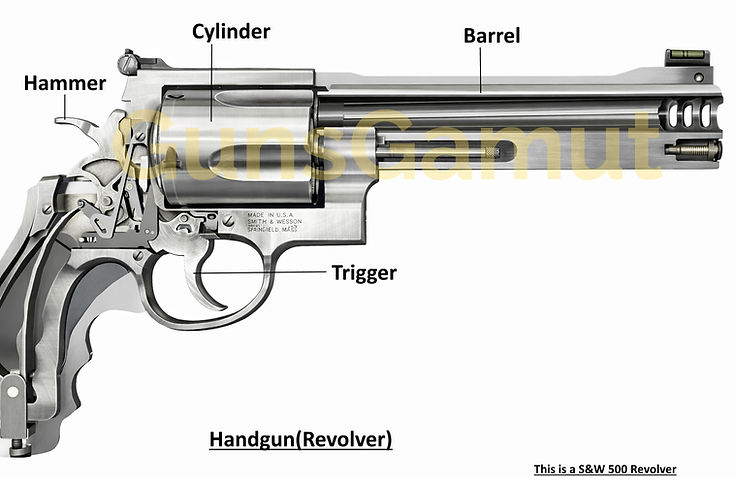
The revolver is one of the most mechanically distinct handgun designs. Unlike pistols that rely on a reciprocating slide and magazine, a revolver uses a rotating cylinder that contains multiple chambers. Each chamber holds a cartridge and rotates into alignment with the barrel before firing.
Revolvers are known for their simplicity, durability, and reliability. Despite being an older design compared to semi-automatic pistols, they remain widely used in personal defense, sport shooting, and specialized roles.
Mechanical Layout of a Revolver
A revolver consists of several major structural components that work together to rotate the cylinder, align cartridges, and fire.
Frame
The frame is the main body of the revolver and supports all other components.
Frame types include:
-
Solid frame
-
Top-break frame
-
Swing-out cylinder frame (most common today)
Modern revolver frames are typically made from steel or aluminum alloy. Steel frames handle higher pressures, while alloy frames reduce weight.
Cylinder
The cylinder is the defining feature of a revolver. It contains multiple chambers arranged around a central axis.
Typical capacities:
-
5 rounds
-
6 rounds
-
7–8 rounds (in some modern designs)
Each chamber functions as an individual firing chamber. When the trigger is pulled or the hammer cocked, the cylinder rotates to bring a fresh chamber into alignment with the barrel.
Barrel
The barrel provides projectile guidance and stabilization through rifling.
Barrel lengths vary widely and affect:
-
Velocity
-
Accuracy
-
Handling
-
Recoil control
Unlike pistols, revolvers have a small gap between the cylinder and barrel known as the cylinder gap, which allows gas escape and slightly reduces velocity.
Hammer
The hammer strikes the firing pin or primer.
It can operate in:
-
Single-action mode
-
Double-action mode
Some modern revolvers use internal hammers or shrouded hammer designs for snag-free carry.
Trigger Mechanism
The trigger performs multiple tasks:
-
Rotates the cylinder
-
Cocks the hammer (in double-action)
-
Releases the hammer
Trigger pull weight and smoothness significantly affect accuracy.
Ejector Rod
The ejector rod is used to remove spent cases from the cylinder.
When pressed, it pushes all cartridge cases out simultaneously.
Revolver Operating Cycle
The firing sequence in a revolver is mechanically straightforward.
-
Trigger is pulled or hammer is cocked
-
Cylinder rotates to align chamber with barrel
-
Hammer falls
-
Primer ignites cartridge
-
Bullet travels through barrel
-
Cylinder remains in position until next trigger pull
This process repeats for each chamber.
Unlike pistols, there is no automatic extraction or feeding cycle. Each chamber is preloaded with a cartridge.
Action Types
Single-Action Revolvers
In single-action revolvers, the hammer must be manually cocked before each shot.
Pulling the trigger only releases the hammer.
Characteristics:
-
Light trigger pull
-
High accuracy potential
-
Slower firing rate
Often used in sport shooting and historical designs.
Double-Action Revolvers
In double-action revolvers, pulling the trigger both cocks and releases the hammer.
Characteristics:
-
Heavier trigger pull
-
Faster firing
-
Simpler operation
Widely used in defensive revolvers.
Double-Action/Single-Action
Most modern revolvers allow both modes.
The shooter can manually cock the hammer for a lighter single-action shot or fire double-action for faster use.
Cylinder Locking and Timing
Cylinder timing refers to the precise alignment of the chamber with the barrel when the hammer falls.
Key components include:
-
Cylinder stop
-
Hand/pawl
-
Ratchet
-
Locking bolt
Proper timing ensures:
-
Accurate alignment
-
Safe firing
-
Reduced wear
Poor timing can cause misalignment and potential damage.
Revolver Calibers
Revolvers can chamber a wide range of cartridges, from low-power rimfire rounds to powerful magnum cartridges.
Common calibers include:
-
.22 LR
-
.32 caliber cartridges
-
.38 Special
-
.357 Magnum
-
.44 Magnum
Revolvers are capable of handling powerful cartridges because the chamber is fully supported within the cylinder.
Barrel Length and Performance
Barrel length affects:
-
Muzzle velocity
-
Sight radius
-
Recoil control
-
Concealability
Short barrels:
-
Easier to carry
-
Lower velocity
-
More recoil
Long barrels:
-
Higher velocity
-
Better accuracy
-
Increased weight
Recoil Characteristics
Revolver recoil differs from pistol recoil because:
-
There is no reciprocating slide
-
Frame absorbs recoil directly
-
Cylinder gap releases gas
Magnum revolvers produce significant recoil due to high-pressure cartridges and lighter firearm weight.
Advantages of Revolvers
-
Mechanical simplicity
-
High reliability
-
Less sensitive to ammunition variations
-
Can remain loaded for long periods
-
Capable of firing powerful cartridges
If a cartridge fails to fire, pulling the trigger again rotates to a new chamber.
Limitations
-
Lower ammunition capacity
-
Slower reload times
-
Wider profile due to cylinder
-
Gas loss at cylinder gap
-
Heavier trigger pull in double-action
These factors influence modern use compared to pistols.
Revolver Size Categories
Snub-Nose Revolvers
-
Short barrels
-
Compact size
-
Designed for concealed carry
Service Revolvers
-
Medium barrel length
-
Balanced size
-
Used historically by police
Magnum Revolvers
-
Large frames
-
Chambered for powerful cartridges
-
Used for hunting or sport
Reloading Methods
Revolvers are reloaded by:
-
Opening cylinder
-
Ejecting spent cases
-
Inserting new cartridges
Reloading tools include:
-
Speedloaders
-
Moon clips
-
Speed strips
These devices improve reload speed but still remain slower than magazine changes in pistols.
Role of Revolvers in Modern Firearms
Although pistols dominate military and law-enforcement use, revolvers remain relevant due to their reliability and simplicity.
They are often used for:
-
Personal defense
-
Backup firearms
-
Training
-
Sporting use
Their mechanical transparency also makes them valuable for studying firearm timing and trigger mechanics.
Engineering Significance
Revolvers provide insight into:
-
Mechanical timing systems
-
Cylinder indexing
-
Trigger linkage design
-
Recoil dynamics
-
Cartridge pressure handling
Understanding revolver mechanics is essential for a complete technical study of handgun systems.
Summary
The revolver represents a mechanically simple yet highly effective handgun design. Its rotating cylinder system offers reliability and the ability to fire powerful cartridges without relying on a complex feeding cycle.
While modern pistols dominate many roles, revolvers remain important in both practical use and technical study. Their design highlights the balance between simplicity, durability, and ballistic performance in compact firearms.