
The Science of Firearms: Understanding the Engineering Behind Modern Weapons
Firearms are often viewed only as instruments of combat or defense, but in reality, they are among the most refined mechanical systems ever developed by engineering. Every modern rifle or pistol represents a carefully balanced machine that combines physics, chemistry, thermodynamics, metallurgy, and precision manufacturing into a single functioning platform. A firearm is not simply a device that “fires a bullet.” It is an energy conversion system designed to withstand extreme pressure, intense heat, and rapid mechanical cycling within fractions of a second. Understanding firearms scientifically requires looking beyond the surface and studying the weapon as an applied engineering system shaped by natural laws.
At the heart of firearm science lies the transformation of chemical energy stored inside propellant into kinetic energy carried by the projectile. When the trigger is pressed, the firearm initiates a controlled chain of events that produces one of the fastest mechanical processes in human technology. Within milliseconds, ignition occurs, gases expand, the bullet accelerates, recoil is generated, and the operating mechanism resets for the next shot. This entire sequence is governed not by mystery, but by strict scientific principles.
Steps of the Firearm Firing Mechanism (Firing Cycle Explained) Figure Below.
The firing mechanism of a firearm follows a precise mechanical sequence known as the firing cycle or shooting cycle. This process ensures reliable ignition, bullet discharge, and automatic preparation for the next round.
1. Trigger Pull (Trigger Activation)
The firing sequence begins when the shooter presses the trigger, releasing the internal fire-control components. This action initiates the firing mechanism by disengaging the sear.
2. Hammer Strike (Firing Pin Impact)
Once released, the hammer or striker moves forward under spring pressure and strikes the firing pin, delivering a strong impact to the primer.
3. Cartridge Detonation and Propellant Ignition
The firing pin ignites the primer, which then ignites the gunpowder or propellant inside the cartridge case, creating rapidly expanding high-pressure gases.
4. Bullet Firing and Barrel Acceleration
The expanding gases force the bullet forward through the barrel. The bullet engages the rifling grooves, gaining velocity and spin stabilization before exiting the muzzle.
5. Extraction of the Spent Cartridge Case
After firing, the bolt or slide moves rearward, and the extractor claw grips the rim of the spent casing, pulling it out of the chamber.
6. Ejection of the Spent Case
As the casing is extracted, it strikes the ejector, which expels the spent case out of the firearm through the ejection port.
7. Feeding a New Cartridge (Chamber Reloading)
The firearm then feeds a fresh round from the magazine into the chamber, preparing the weapon for the next shot in semi-automatic or automatic operation.

Firearms Works under the principle of conservation of energy
Suppose the gunpowder produces energy 'E' = 100J on detonation.
Let the bullet mass be 'm' and the mass of the gun is 'M'.
And 'V' be the recoil velocity of the gun and 'v' is the muzzle velocity of the bullet.
then,

Internal Ballistics: The Science Inside the Chamber and Barrel
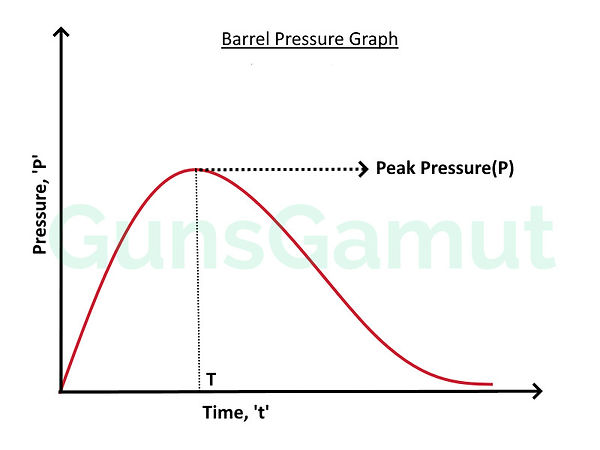
The most important scientific phase of firearm operation begins inside the chamber, in the field known as internal ballistics. The moment the primer is struck, it ignites the propellant powder, creating rapidly expanding gases. These gases do not explode instantaneously but burn progressively at extremely high temperatures, generating pressure that can exceed fifty thousand pounds per square inch in many modern rifle cartridges. This pressure is what forces the bullet to overcome inertia, engage the rifling, and accelerate forward through the barrel.
The barrel acts as a pressure vessel as well as an acceleration tube. As the bullet travels down the bore, expanding gases continue to push it forward until it reaches the muzzle. The relationship between pressure, burn rate, bore friction, barrel length, and bullet resistance determines muzzle velocity. This is why internal ballistic design is one of the most complex engineering challenges in firearms development. Even small changes in chamber geometry, propellant composition, or projectile mass can significantly alter performance and safety.
Rifling and Bullet Stability: Rotational Physics of Accuracy

One of the most important advancements in firearms science is rifling, which transformed firearms from inaccurate smoothbore weapons into precision instruments. Rifling consists of helical grooves cut into the barrel interior that force the bullet to spin as it travels forward. This spin produces gyroscopic stability, allowing the projectile to remain nose-forward during flight rather than tumbling unpredictably through the air.
The stability of a bullet depends on the relationship between rifling twist rate, bullet length, velocity, and aerodynamic shape. Longer projectiles require faster twist rates, while shorter bullets stabilize with slower twist. This is why modern firearms engineering must match ammunition design with barrel specifications. Rifling is not merely a mechanical feature; it is the direct application of rotational dynamics and stability physics.
This is how the barrel pressure is developed when a particular bullet travels inside the barrel before exiting it. See the graph below
Recoil Dynamics: Newton’s Laws Governing Firearms
Every firearm produces recoil, and recoil is one of the purest demonstrations of Newtonian mechanics in applied engineering. Newton’s Third Law states that for every action, there is an equal and opposite reaction. When a bullet moves forward at high velocity, the firearm must move backward with equal momentum. This backward force is experienced by the shooter as recoil.
Recoil is not determined only by caliber, but by the entire momentum system of the shot. Projectile mass, muzzle velocity, powder gas contribution, firearm weight, and action design all contribute to recoil impulse. Engineers do not eliminate recoil, because physics does not allow it; instead, they manage recoil by spreading its impulse over time through springs, buffers, gas systems, muzzle brakes, and ergonomic stock design.
External Ballistics: The Scientific Behavior of Bullets in Flight
Once the bullet exits the muzzle, it enters the realm of external ballistics, where aerodynamics and gravity control its flight. Contrary to popular belief, a bullet does not travel in a straight line. Gravity begins pulling it downward immediately after it leaves the barrel, creating a curved trajectory. At the same time, air resistance slows the projectile, while crosswinds introduce lateral drift.
Bullet flight is shaped heavily by its ballistic coefficient, a measure of aerodynamic efficiency. A projectile with a high ballistic coefficient retains velocity longer, drops less, and resists wind drift more effectively. This is why long-range ammunition is designed with streamlined shapes, optimized mass distribution, and minimal drag profiles.
A trajectory cutaway diagram showing bullet arc and wind drift demonstrates clearly that marksmanship is not guesswork, but applied physics. Every long-range shot is the result of gravitational prediction, aerodynamic calculation, and environmental correction.
Terminal Ballistics: Energy Transfer and Impact Science
The final stage of firearm science is terminal ballistics, which studies what occurs when a projectile impacts a target. Terminal effects depend on velocity, projectile construction, impact angle, and material resistance. Penetration, fragmentation, cavitation, and energy transfer are all governed by kinetic energy and momentum behavior.
Kinetic energy increases with the square of velocity, meaning that rifle rounds carry dramatically greater energy than pistol rounds even if bullet weights appear similar. This is why rifles achieve deeper penetration and greater terminal effects at distance. Terminal ballistics is critical in military engineering, forensic analysis, and ammunition development because it connects projectile mechanics to real-world outcomes.
Firearm Operating Mechanisms: Mechanical Engineering Under Extreme Speed
Modern firearms are also remarkable for their operating systems, which allow semi-automatic or automatic cycling. After firing, the weapon must extract the spent casing, eject it, chamber a new round, and reset the firing mechanism—all within fractions of a second. This requires extremely precise mechanical timing.
Different firearm platforms use different energy harnessing systems. Blowback firearms depend on bolt mass and spring resistance. Recoil-operated pistols use barrel-slide locking geometry and controlled unlocking movement. Gas-operated rifles redirect propellant gases through a port to drive pistons or direct impingement systems. Each mechanism is a mechanical engineering solution designed to balance reliability, durability, and controllability under extreme stress.
Cutaway diagrams of these cycling systems reveal firearms as automated machines rather than simple launch devices. Their function is closer to high-speed industrial machinery than to basic weapons.
Materials Science: Metallurgy and Durability in Firearms
Firearms operate under pressures and temperatures that would destroy ordinary machines, making materials science essential. Barrels and bolts are typically made from high-strength alloy steels, treated through heat processes such as quenching, tempering, nitriding, or chrome lining. These treatments improve hardness, fatigue resistance, and corrosion protection.
Modern firearm manufacturing increasingly incorporates aluminum alloys and reinforced polymers, particularly in receivers and frames, reducing weight while maintaining structural performance. The science of firearm materials ensures that weapons withstand tens of thousands of firing cycles without catastrophic failure.
Firearms as Applied Science and Engineering Systems
The science of firearms is ultimately the science of controlled energy, precision engineering, and mechanical reliability under extreme conditions. From the ignition chemistry inside the cartridge to the aerodynamic flight of the bullet, from recoil momentum to high-pressure metallurgy, firearms represent one of the most complete examples of applied physics in modern technology.
To study firearms scientifically is to understand them not merely as weapons, but as engineered machines shaped by thermodynamics, mechanics, and materials research. At GunsGamut.com, this scientific approach forms the foundation of serious firearms knowledge—moving beyond superficial discussion and into the true engineering reality behind small arms.