
This section introduces the fundamental scientific principles that govern projectile behavior from the moment a firearm is fired until the projectile reaches its target. Ballistics is typically divided into internal, external, and terminal phases, each describing how energy, pressure, velocity, and environmental forces influence projectile motion and performance.
Understanding the basics of ballistics is essential for analyzing firearm efficiency, accuracy, recoil behavior, and projectile stability. The following overview outlines the core ballistic stages and the physical concepts that determine how projectiles accelerate, travel through the air, and interact with targets in modern firearm systems.
Basics of Ballistics
Ballistics is the science that studies the behavior of a projectile in motion — from the moment it is fired, through its flight, until it impacts the target. Understanding ballistics is essential for professionals, researchers, engineers, and firearm enthusiasts because it explains how ammunition performs in real conditions.
Ballistics is generally divided into three major domains:
Interior Ballistics
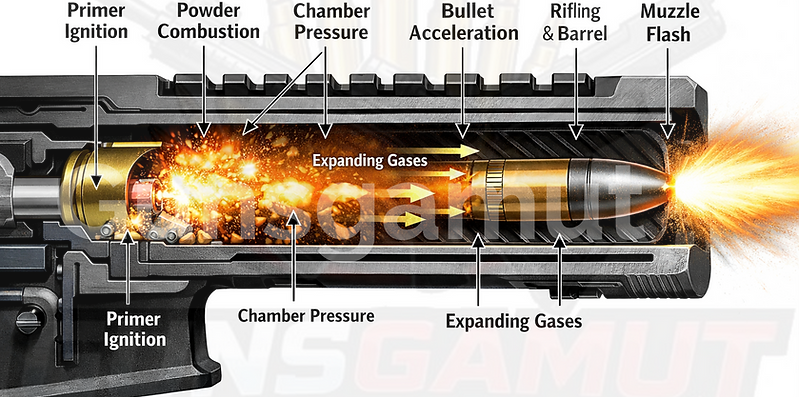
Internal ballistics is the branch of ballistics that focuses on the events occurring inside the firearm from the instant the firing pin strikes the primer until the projectile exits the muzzle. This phase begins with primer ignition, which initiates the rapid combustion of the propellant powder. As the powder burns, high-temperature gases are generated, creating a sharp rise in chamber pressure. This pressure acts on the base of the bullet, forcing it to overcome inertia and engraving resistance as it engages with the barrel’s rifling. During its travel down the bore, the bullet accelerates continuously, while pressure evolves depending on factors such as propellant burn rate, case volume, barrel length, and projectile mass. Internal ballistics also includes critical phenomena such as peak pressure limits, gas expansion efficiency, frictional forces between bullet and bore, and the influence of firearm mechanisms like gas ports in semi-automatic weapons. Proper understanding of internal ballistics is essential for firearm safety, ammunition design, recoil prediction, and optimizing muzzle velocity and overall weapon performance.
Internal ballistics deals with everything that happens inside the firearm from ignition until the bullet exits the barrel.
Key processes include:
-
Primer ignition and powder combustion
-
Pressure generation inside the chamber
-
Bullet acceleration through the barrel
-
Rifling engagement and stabilization
-
Muzzle velocity development
Internal ballistics is heavily influenced by:
-
Cartridge design
-
Propellant type and burn rate
-
Barrel length
-
Chamber pressure limits
-
Bullet weight and seating depth
This phase directly determines the firearm’s power, efficiency, and safety.
Internal ballistics is the branch of ballistics that focuses on the events occurring inside the firearm from the instant the firing pin strikes the primer until the projectile exits the muzzle. This phase begins with primer ignition, which initiates the rapid combustion of the propellant powder. As the powder burns, high-temperature gases are generated, creating a sharp rise in chamber pressure. This pressure acts on the base of the bullet, forcing it to overcome inertia and engraving resistance as it engages with the barrel’s rifling. During its travel down the bore, the bullet accelerates continuously, while pressure evolves depending on factors such as propellant burn rate, case volume, barrel length, and projectile mass. Internal ballistics also includes critical phenomena such as peak pressure limits, gas expansion efficiency, frictional forces between bullet and bore, and the influence of firearm mechanisms like gas ports in semi-automatic weapons. Proper understanding of internal ballistics is essential for firearm safety, ammunition design, recoil prediction, and optimizing muzzle velocity and overall weapon performance.